Resources Page
From those considering flight training to students already enrolled, our resource library is designed to answer questions, provide guidance, and help you navigate every stage of becoming a pilot.
Flight Planning & Navigation
Weather resources
FAA & Regulations
Study & Ground school
Radio Communications
Career & Industry
Student Favorites
FAA Rating Requirements
The following regulations are quoted directly from the Code of Federal Regulations (CFR). To make these requirements easier to understand, we have included simplified reference tables below.
These figures represent nationwide averages and are provided for planning purposes only. Actual training costs vary based on aircraft rental rates, instructor fees, student proficiency, training frequency, and local operating expenses. Most students require flight time beyond FAA minimums to become checkride-ready.
- Private Pilot
- Instrument Rating
- Commercial Rating
- Flight Inst.
- Multi- Engine
From 14 CFR § 61.109
Airplane Single-Engine
A person who applies for a private pilot certificate with an airplane category and single-engine class rating must log at least 40 hours of flight time that includes at least 20 hours of flight training from an authorized instructor and 10 hours of solo flight training in the areas of operation listed in § 61.107(b)(1) of this part, and the training must include at least:
- 3 hours of cross-country flight training in a single-engine airplane;
- Except as provided in § 61.110 of this part, 3 hours of night flight training in a single-engine airplane that includes –
- One cross-country flight of over 100 nautical miles total distance; and
- 10 takeoffs and 10 landings to a full stop (with each landing involving a flight in the traffic pattern) at an airport.
- 3 hours of flight training in a single-engine airplane on the control and maneuvering of an airplane solely by reference to instruments, including straight and level flight, constant airspeed climbs and descents, turns to a heading, recovery from unusual flight attitudes, radio communications, and the use of navigation systems/facilities and radar services appropriate to instrument flight;
- 3 hours of flight training with an authorized instructor in a single-engine airplane in preparation for the practical test, which must have been performed within the preceding 2 calendar months from the month of the test; and
- 10 hours of solo flight time in a single-engine airplane, consisting of at least –
- 5 hours of solo cross-country time;
- One solo cross country flight of 150 nautical miles total distance, with full-stop landings at three points, and one segment of the flight consisting of a straight-line distance of more than 50 nautical miles between the takeoff and landing locations; and
- Three takeoffs and three landings to a full stop (with each landing involving a flight in the traffic pattern) at an airport with an operating control tower.
From 14 CFR § 61.65
A person who applies for an instrument rating must:
- Hold at least a current private pilot certificate, or be concurrently applying for a private pilot certificate, with an airplane, helicopter, or powered-lift rating appropriate to the instrument rating sought;
- Be able to read, speak, write, and understand the English language. If the applicant is unable to meet any of these requirements due to a medical condition, the Administrator may place such operating limitations on the applicant’s pilot certificate as are necessary for the safe operation of the aircraft;
- Receive and log ground training from an authorized instructor or accomplish a home-study course of training on the aeronautical knowledge areas of paragraph (b) of this section that apply to the instrument rating sought;
- Receive a logbook or training record endorsement from an authorized instructor certifying that the person is prepared to take the required knowledge test;
- Receive and log training on the areas of operation of paragraph (c) of this section from an authorized instructor in an aircraft, full flight simulator, or flight training device that represents an airplane, helicopter, or powered-lift appropriate to the instrument rating sought;
- Receive a logbook or training record endorsement from an authorized instructor certifying that the person is prepared to take the required practical test;
- Pass the required knowledge test on the aeronautical knowledge areas of paragraph (b) of this section; however, an applicant is not required to take another knowledge test when that person already holds an instrument rating; and
- Pass the required practical test on the areas of operation in paragraph (c) of this section in –
- An airplane, helicopter, or powered-lift appropriate to the rating sought; or
- A full flight simulator or a flight training device appropriate to the rating sought and for the specific maneuver or instrument approach procedure performed. If an approved flight training device is used for the practical test, the instrument approach procedures conducted in that flight training device are limited to one precision and one non precision approach, provided the flight training device is approved for the procedure performed.
From 14 CFR § 61.129
Airplane Commercial Single Engine
A person who applies for a commercial pilot certificate with an airplane category and single-engine class rating must log at least 250 hours of flight time as a pilot that consists of at least:
- 100 hours in powered aircraft, of which 50 hours must be in airplanes.
- 100 hours of pilot-in-command flight time, which includes at least –
- 50 hours in airplanes; and
- 50 hours in cross-country flight of which at least 10 hours must be in airplanes.
- 20 hours of training on the areas of operation listed in § 61.127(b)(1) of this part that includes at least –
- Ten hours of instrument training using a view-limiting device including attitude instrument flying, partial panel skills, recovery from unusual flight attitudes, and intercepting and tracking navigational systems. Five hours of the 10 hours required on instrument training must be in a single engine airplane;
- 10 hours of training in a complex airplane, a turbine-powered airplane, or a technically advanced airplane (TAA)that meets the requirements of paragraph (j) of this section, or any combination thereof. The airplane must be appropriate to land or sea for the rating sought;
- One 2-hour cross country flight in a single engine airplane in daytime conditions that consists of a total straight-line distance of more than 100 nautical miles from the original point of departure;
- One 2-hour cross country flight in a single engine airplane in nighttime conditions that consists of a total straight-line distance of more than 100 nautical miles from the original point of departure; and
- Three hours in a single-engine airplane with an authorized instructor in preparation for the practical testwithin the preceding 2 calendar months from the month of the test.
- Ten hours of solo flight time in a single engine airplane or 10 hours of flight time performing the duties of pilot in command in a single engine airplane with an authorized instructor on board (either of which may be credited towards the flight time requirement under paragraph (a)(2) of this section), on the areas of operation listed under § 61.127(b)(1) that include –
- One cross-country flight of not less than 300 nautical miles total distance, with landings at a minimum of three points, one of which is a straight-line distance of at least 250 nautical miles from the original departure point. However, if this requirement is being met in Hawaii, the longest segment need only have a straight-line distance of at least 150 nautical miles; and
- 5 hours in night VFR conditions with 10 takeoffs and 10 landings (with each landing involving a flight in the traffic pattern) at an airport with an operating control tower.
From 14 CFR § 61.183
Airplane Single-Engine
To be eligible for a flight instructor certificate or rating a person must:
- Be at least 18 years of age;
- Be able to read, speak, write, and understand the English language. If the applicant is unable to meet one of these requirements due to medical reasons, then the Administrator may place such operating limitations on that applicant’s flight instructor certificate as are necessary;
- Hold either a commercial pilot certificate or airline transport pilot certificate with:
- An aircraft category and class rating that is appropriate to the flight instructor rating sought; and
- An instrument rating, or privileges on that person’s pilot certificate that are appropriate to the flight instructor rating sought, if applying for –
- A flight instructor certificate with an airplane category and single-engine class rating;
- A flight instructor certificate with an airplane category and multiengine class rating;
- A flight instructor certificate with a powered-lift rating; or
- A flight instructor certificate with an instrument rating.
- Receive a logbook endorsement from an authorized instructor on the fundamentals of instructing listed in § 61.185of this part appropriate to the required knowledge test;
- Pass a knowledge test on the areas listed in § 61.185(a)(1)of this part, unless the applicant:
- Holds a flight instructor certificate or ground instructor certificate issued under this part;
- Holds a teacher’s certificate issued by a State, county, city, or municipality that authorizes the person to teach at an educational level of the 7th grade or higher; or
- Is employed as a teacher at an accredited college or university.
- Pass a knowledge test on the aeronautical knowledge areas listed in § 61.185(a)(2) and (a)(3) of this part that are appropriate to the flight instructor rating sought;
- Receive a logbook endorsement from an authorized instructor on the areas of operation listed in § 61.187(b) of this part, appropriate to the flight instructor rating sought;
- Pass the required practical test that is appropriate to the flight instructor rating sought in an:
- Aircraft that is representative of the category and class of aircraft for the aircraft rating sought; or
- Flight simulator or approved flight training device that is representative of the category and class of aircraft for the rating sought, and used in accordance with a course at a training center certificated under part 142 of this chapter.
- Accomplish the following for a flight instructor certificate with an airplane or a glider rating:
- Receive a logbook endorsement from an authorized instructor indicating that the applicant is competent and possesses instructional proficiency in stall awareness, spin entry, spins, and spin recovery procedures after providing the applicant with flight training in those training areas in an airplane or glider, as appropriate, that is certificated for spins; and
- Demonstrate instructional proficiency in stall awareness, spin entry, spins, and spin recovery procedures. However, upon presentation of the endorsement specified in paragraph (i)(1) of this section an examiner may accept that endorsement as satisfactory evidence of instructional proficiency in stall awareness, spin entry, spins, and spin recovery procedures for the practical test, provided that the practical test is not a retest as a result of the applicant failing the previous test for deficiencies in the knowledge or skill of stall awareness, spin entry, spins, or spin recovery instructional procedures. If the retest is a result of deficiencies in the ability of an applicant to demonstrate knowledge or skill of stall awareness, spin entry, spins, or spin recovery instructional procedures, the examiner must test the person on stall awareness, spin entry, spins, and spin recovery instructional procedures in an airplane or glider, as appropriate, that is certificated for spins;
- Log at least 15 hours as pilot in command in the category and class of aircraft that is appropriate to the flight instructor rating sought; and
- Comply with the appropriate sections of this part that apply to the flight instructor rating sought.
From 14 CFR § 61.109
Airplane Multi-Engine
A person who applies for a private pilot certificate with an airplane category and multiengine class rating must log at least 40 hours of flight time that includes at least 20 hours of flight training from an authorized instructor and 10 hours of solo flight training in the areas of operation listed in § 61.107(b)(2) of this part, and the training must include at least –
- 3 hours of cross-country flight training in a multiengine airplane;
- Except as provided in § 61.110 of this part, 3 hours of night flight training in a multiengine airplane that includes –
- One cross-country flight of over 100 nautical miles total distance; and
- 10 takeoffs and 10 landings to a full stop (with each landing involving a flight in the traffic pattern) at an airport.
- 3 hours of flight training in a multiengine airplane on the control and maneuvering of an airplane solely by reference to instruments, including straight and level flight, constant airspeed climbs and descents, turns to a heading, recovery from unusual flight attitudes, radio communications, and the use of navigation systems/facilities and radar services appropriate to instrument flight;
- 3 hours of flight training with an authorized instructor in a multiengine airplane in preparation for the practical test, which must have been performed within the preceding 2 calendar months from the month of the test; and
- 10 hours of solo flight time in an airplane consisting of at least –
- 5 hours of solo cross-country time;
- One solo cross country flight of 150 nautical miles total distance, with full-stop landings at three points, and one segment of the flight consisting of a straight-line distance of more than 50 nautical miles between the takeoff and landing locations; and
- Three takeoffs and three landings to a full stop (with each landing involving a flight in the traffic pattern) at an airport with an operating control tower.
Private Pilot
Learn the fundamentals and earn your wings.- Student Pilot Certificate (No Cost)
- Minimum Age: 16yrs (Solo) 17yrs (Private Pilot)
- Pass the required written knowledge test (PAR)
- 40 hours total flight time
- 20 hours dual instruction
- 10 hours solo flight time
- 3 hours cross-country (XC) training
- 3 hours night training
- 3 hours instrument training
- 3 hours checkride preparation within 2 calendar months of practical test
- 5 hours solo cross-country
- One solo XC flight of at least 150nm total distance w/ full-stop landings at three airports
- Three solo takeoffs and landings at a towered airport
Instrument Rating
Enhance your skills, confidence, and capability.- Private Pilot Certificate
- Minimum Age: 17yrs
- Pass the required written knowledge test (IRA)
- 50 hours cross-country time PIC (Pilot-in-Command)
- 40 hours of actual or simulated instrument time
- One IFR cross-country flight that consists of the following:
- 250nm along airways or ATC-routed flight
- Three different types of navigation utilized
- Three different types of instrument approaches
Commercial Pilot
Turn your passion for flying into a profession- Private Pilot Certificate
- No Instrument Rating required however, limitations apply.
- Minimum Age: 18yrs
- Pass the required written knowledge test (CAX)
- 250 hours total flight time*
- 100 hours PIC
- 50 hours cross-country
- 100 hours in powered aircraft
- 50 hours in airplanes
- 20 hours dual instruction
- 10 hours instrument training
- 10 hours in a complex or TAA (Technically Advanced Airplane)
- One daytime XC flight of at least 300 NM with landings at three points and one leg over 250 NM
- 5 hours night VFR
- 10 takeoffs and 10 landings at a towered airport
- One night cross-country of at least 100 NM total distance
- 10 hours solo including the required XC flights**
- *50 hours may be substituted in AATD (Approved Simulator)
- **Can be satisfied by performing PIC Duties with an instructor
Certified Flight Instructor (CFI)
Lead, mentor, and grow as an aviation professional.- Commercial Pilot Certificate
- Instrument Rating
- Minimum Age: 18yrs
- Pass the two written knowledge tests (FOI / FIA)
- 250 hours total flight time
- Recieve logbook endorsements/training from authorized instructor
Certified Flight Instructor - Instrument (CFII)
Teach pilots to navigate the skies under IFR.- Commercial Pilot Certificate
- Instrument Rating
- CFI Certificate
- Minimum Age: 18yrs
- Pass the written knowledge test (FII)
- 250 hours total flight time
- Recieve logbook endorsements/training from authorized instructor
Multi-Engine Pilot (Private & Commercial)
Double the engines. Double the possibilities.- Private or Commercial Certificate
- Minimum Age depends on Private vs Commercial
- No minimum hour requirements
- No additional written knowledge tests
- Can usually be completed with under 10 hours of training
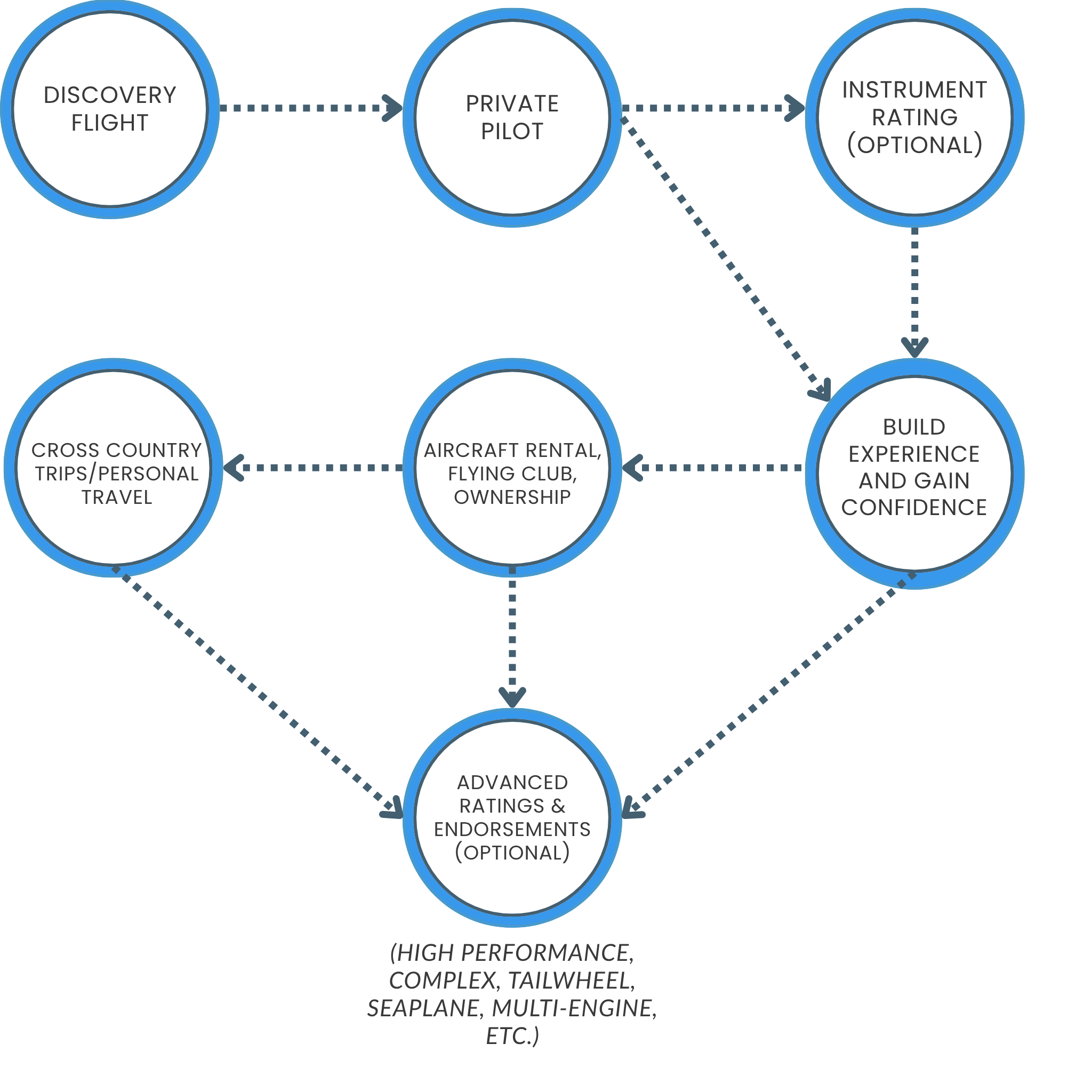
Choose your destination
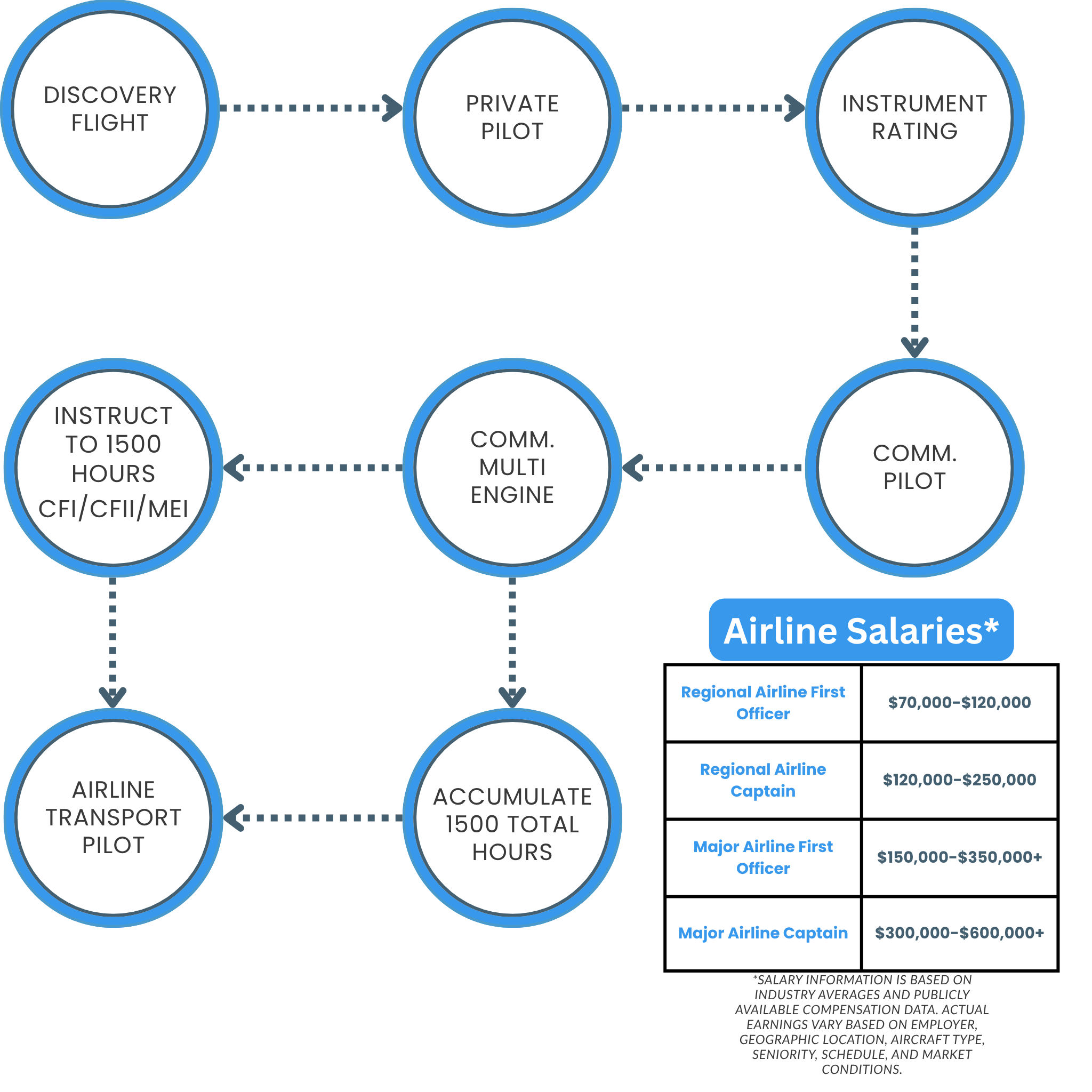
- Airlines
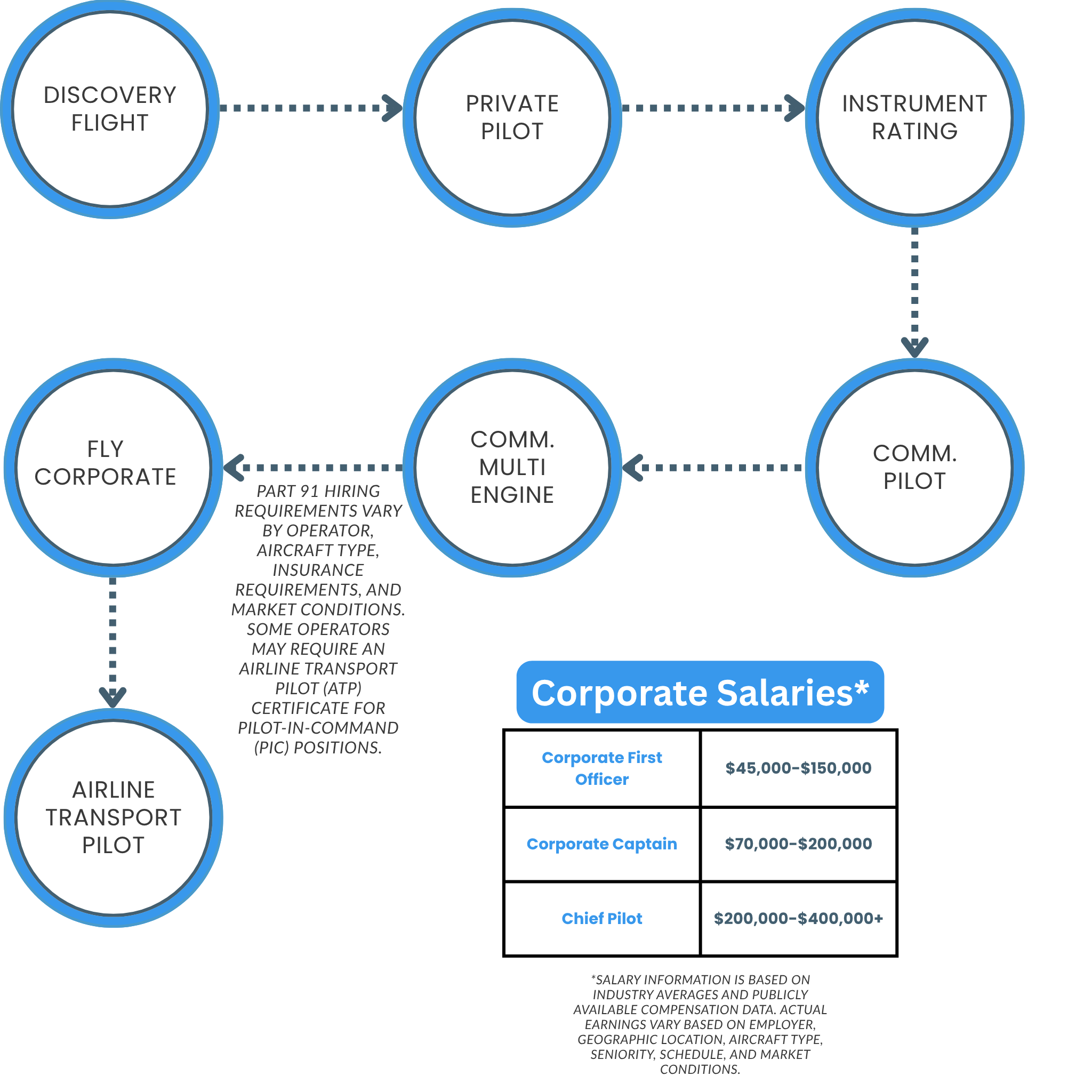
- Corporate
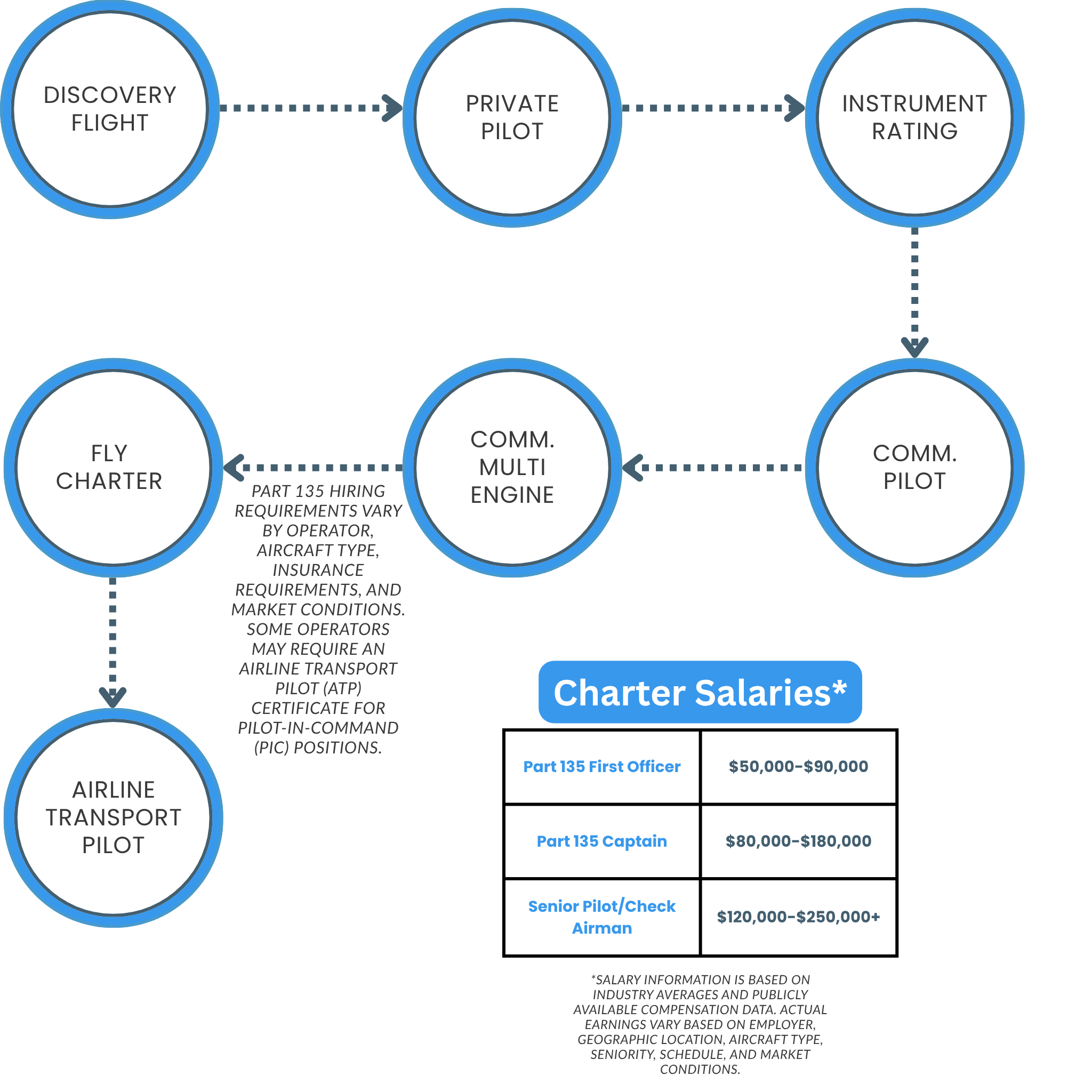
- Charter
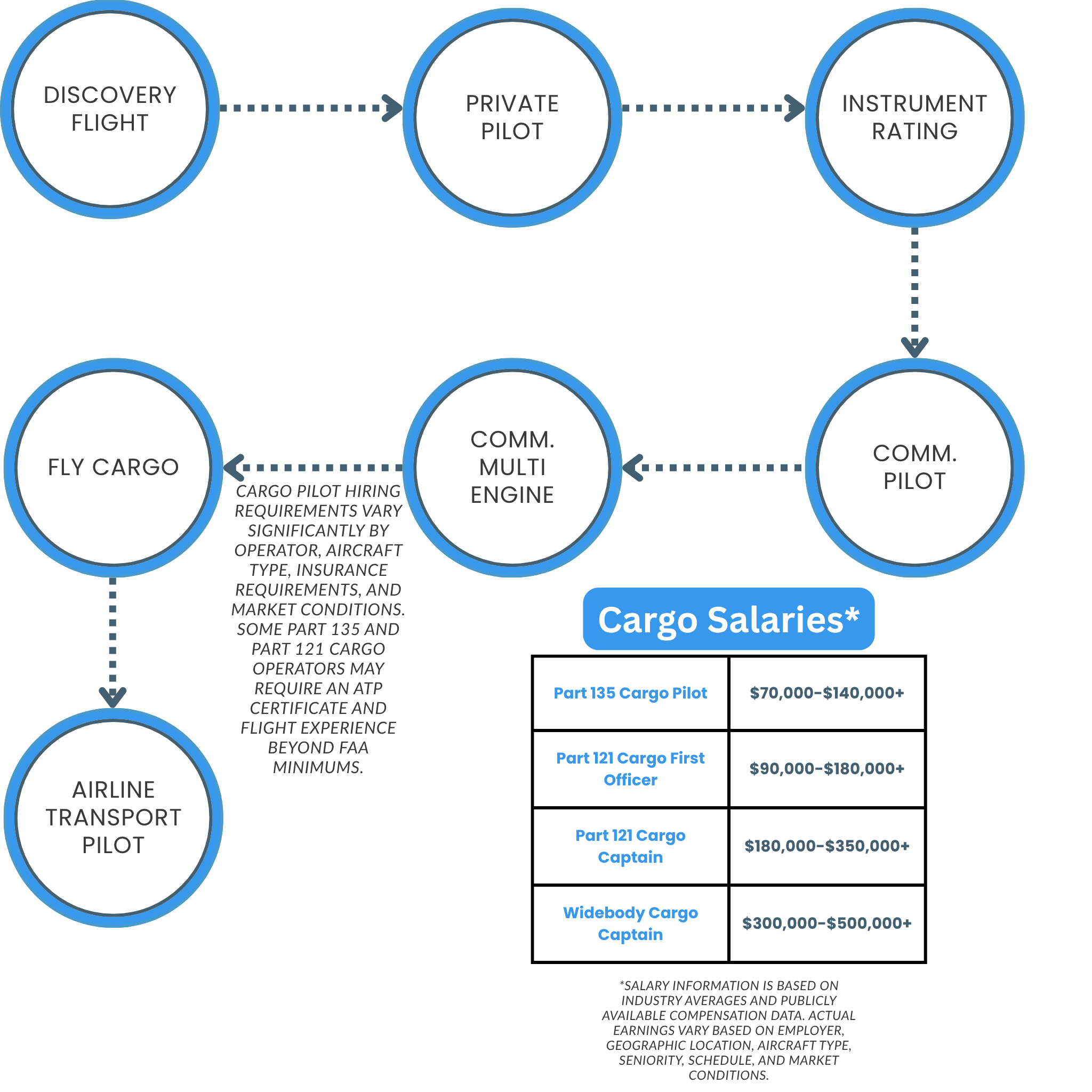
- Cargo
- Recreational
Not every pilot is pursuing an airline or commercial career. Many people learn to fly for the freedom, adventure, and personal accomplishment that aviation offers. Whether you’re flying for weekend getaways, family trips, business travel, or simply the love of aviation, the recreational path can be incredibly rewarding.